

Conversation identifiers and persistence
Overview
Ada assigns identifiers to help track users and Conversations across Channels. These identifiers determine when a conversation begins and ends, how messages are grouped, and whether a returning user is recognized or treated as new. Persistence settings, user behavior, and channel differences all influence how these identifiers change over time.
This topic explains how conversation and user identifiers relate to each other, how they are assigned, and how persistence governs session continuity across Chat, Email, Social, and Voice interactions. It also includes examples that illustrate how identifiers behave in different scenarios.
To learn how variables are stored and reused during conversations, see this section.
Conversation and user identifiers
Ada uses several identifiers to represent different levels of user and conversation context.
conversation_id
Represents a single conversation thread. A new conversation_id is created when:
- a new Web Chat session begins
- a previous conversation times out
- the user manually ends chat (depending on persistence)
- an email reply arrives outside the continuation window
- a social platform creates a new messaging thread
- a call begins in a voice channel
conversation_id is included in data exports.
chatter_id
Represents the browser or device session for Web Chat. A single chatter_id may map to several different conversation_id values. It appears in the Convos view under Meta variables.
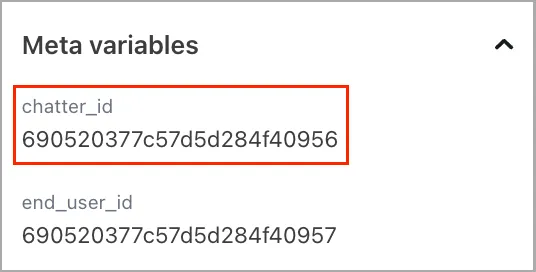
end_user_id
A persistent identifier that represents a user across multiple conversations and channels. It remains stable if the user can be recognized based on persistence rules or channel metadata. This identifier also appears in the Convos view under Meta variables.
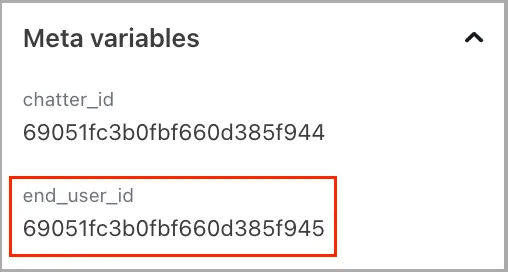
Sunshine Conversations identifiers
For social channels integrated through Sunshine Conversations, your AI Agent may receive external identifiers from the messaging platform. These can include:
sunshine_user_id: The user identifier provided by the external platform.sunshine_conversation_id: The thread or conversation identifier provided by the external platform.
These values appear when Sunshine Conversations is enabled. They reflect identifiers used by the external platform and can help correlate your Agent’s conversations with activity occurring on that platform.
How identifiers relate
Each identifier represents a different layer of identity:
end_user_id: The end user record created for a given interactionchatter_id: The session-level identity used during that interactionconversation_id: The specific conversation thread
Each end_user_id corresponds to exactly one chatter_id, and Ada treats them as a 1:1 representation of the same underlying user.
However, when your system tracks end users by its own stable identifier, the End Users API can associate that identifier with the Ada end user through the external_id field. This is supported for custom channel (Conversations API) integrations: set external_id at creation, and subsequent inbound interactions can look up the same end user by calling GET /v2/end-users/?external_id=<value> to retrieve the existing end_user_id and continue the conversation with a hydrated profile.
What that means
- Inside Ada:
end_user_idandchatter_idare separate identifiers but always refer to the same individual. - Inside your system: For custom channel integrations, use the
external_idfield to recognize returning end users by your own identifier (for example a CRM contact ID) and reuse the same Ada end user across conversations.external_idis unique per AI Agent — one value maps to exactly one end user. - They are not interchangeable and appear in different contexts (e.g., embed exposes
chatter_id, while the End Users API referencesend_user_id).
This ensures Ada can track each session independently while giving you flexibility to recognize returning end users at the application level. See Examples for how a custom channel integration can use external_id to recognize returning end users.
Persistence and session continuity
Web Chat includes configurable persistence settings that determine how returning visitors are recognized. Persistence is evaluated only when the chat widget loads or refreshes.
Effects of persistence
In Messaging, Forget After Reload preserves an active handoff across a page refresh; privateMode preserves no browser session state. See Messaging data controls for this exception.
Conversation timeouts
Conversations end automatically after long periods of inactivity:
- Web Chat and most messaging channels: about 24 hours
- Email: about 72 hours
After timeout, the next message creates a new conversation_id.
Ada also generates a new chatter_id/end_user_id pair for the session. If you want to link session-level identities across devices or time, you can do so using the End Users API. See How identifiers relate for a full explanation of how these values work together.
Cross-channel behavior
For Messaging, identity tokens restore the same end user and conversation across devices. Follow Personalization and identity for backend lookup and session setup.
Identifiers and session continuity behave differently depending on the Channel where the conversation occurs. Each channel has its own rules for how users are recognized, how conversations are grouped, and when new sessions begin. The sections below outline how identity and conversation behavior work across channels.
Web Chat
- Persistence determines session continuity
- Refreshing, closing tabs, and clearing cookies affect
chatter_id conversation_idresets based on session continuity and timeouts
Email
- Identity is based on email address
- Time windows determine conversation grouping
Voice
- Identity is determined by caller phone number
- Each call typically creates a new conversation
Shared devices
When multiple users share a device, identity should be reset to avoid cross-user data exposure. In Web Chat implementations using the Chat SDK (embed), call reset() on logout to generate a new chatter_id and ensure variables and prior conversation context are not reused.
Examples
Use these examples to see how conversation identifiers and persistence behave in real situations. Each scenario highlights how user actions, browser behavior, or channel rules influence whether Ada creates a new conversation or reuses an existing identity.
Returning user in Web Chat with 'Never Forget'
- End user starts chatting with the AI Agent.
chatter_idandend_user_idare assigned.- End user returns later in the same browser.
- A new
conversation_idis created, but the sameend_user_idcontinues. - Persisted variables associated with identity may still be available.
Page refresh with 'Forget After Reload'
- End user begins a Web Chat session.
- They refresh the page.
- A new
chatter_idand newconversation_idare created. - The user appears as new.
Email reply outside continuation window
- End user emails your support address.
- Ada responds, creating a conversation.
- User replies after several days.
- A new
conversation_idis created, but the sameend_user_idis used.
Recognizing returning end users with external_id (custom channels)
This pattern applies only to custom channels through the Conversations API. For Messaging, use backend lookup with identity tokens instead of the custom-channel conversation creation flow.
- An end user contacts the AI Agent for the first time through a custom channel. The integration has a stable identifier for the user in its own system (for example
CRM_12345). - The integration calls
GET /v2/end-users/?external_id=CRM_12345— a404response indicates no Ada end user is mapped to that value yet. - The integration calls
POST /v2/end-users/withexternal_id: "CRM_12345"and any known profile fields (language, metadata). Ada creates the end user with201and stores the mapping. - The integration starts a conversation using the returned
end_user_id. - Later, the same end user contacts the AI Agent again. The integration calls
GET /v2/end-users/?external_id=CRM_12345— this time a200response returns the existingend_user_idand profile data. - The integration starts a new conversation on the same
end_user_id. Ada links both conversations to the same end user record.
In this scenario, the integration uses its own identifier as the lookup key, and Ada maintains the link between that identifier and the end user across conversations. For the full pattern, see Identify end users with a stable external ID.
Related features
- Persistence settings: Configure how returning visitors are recognized and when session identifiers reset.
- Variables: Store and reuse data during conversations, with persistence tied to session continuity.
- Data export: Export conversation data, including
conversation_idand other identifiers. - Data retention: Understand how long conversation data is stored before deletion.
Social messaging