

API Overview
Ada’s suite of APIs opens up multiple integration paths to connect Ada with external systems, extending the capabilities of your AI agent. Whether you’re looking to manage data stored in Ada or personalize conversations, Ada’s APIs supports numerous use cases, including:
- Syncing end user profile information in real time to enable your AI Agent to be knowledgeable about your users and tailor responses.
- Managing and uploading business knowledge and policies from any source.
- Complying with data privacy regulations around data retention and deletion.
- Exporting conversation data for in-depth analysis or long term storage.
Fundamentals
-
Ada’s APIs adhere to REST standards and utilize JSON formatting for data exchange.
-
Secure access is managed through Authentication using rotatable keys.
-
Versioning allows to smoothly opt-in to breaking changes.
-
Global rate limits ensure high availability, with certain API families applying their own local limits.
-
Cursor-based pagination supports efficient handling of large data sets.
API changes — new endpoints, parameters, responses, and deprecations — are tracked in the Release Notes. Filter by the APIs tag to see only API updates. For how breaking changes are introduced and how to opt in, see Versioning.
API testing
To help you get started quickly, you can use these resources to explore the API, run tests, and integrate it into your workflows. They’re designed to reduce setup time and give you hands-on experience with real requests and responses.
Download our OpenAPI spec
You can download the OpenAPI specification below. This file provides a machine-readable definition that you can use with your own tools.
Use our API Playground
Use the API Playground directly in these docs to try out requests and see live responses. This makes it easy to validate endpoints, experiment with parameters, and understand responses before integrating them into your own systems.
Click ▶️ Play
Next to every API call example, you’ll see a ▶️ Play button to open the playground. For example in Knowledge Sources:
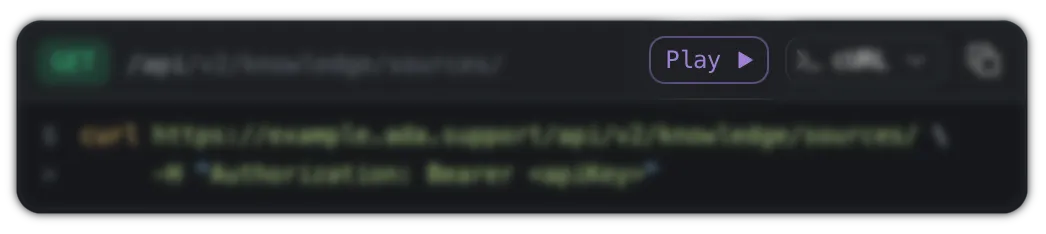
Enter your API key
API families
Knowledge API
Use the Knowledge API to import and sync knowledge articles into Ada.
End Users API
The End Users API offers allows for real-time updates and management of user profile information, including webhook events to track changes in user profiles.
Export API
The Data Export API provides access to conversation and message records. You can use this API to export data into your own data warehouse for analysis and long-term storage.
Compliance API
The Bulk End-User Deletion API erases all personal data associated with one or more end users across Ada’s systems. It replaces the Data Compliance API, which is now deprecated.
Integrations API
The Integrations API enables developers to connect external applications to Ada, such as Knowledge integrations that help AI agents generate responses, all managed from the Ada dashboard.
Conversations API
The Conversations API allows developers to build custom channels and extend Ada into proprietary apps, third-party platforms, or internal tools with developer-focused control.
Tools API
The Tools API lists, fetches, creates, updates, and deletes the HTTP (api) and code (code) tools configured on an AI Agent through one inventory.
Glossary API
The Glossary API lists, fetches, creates, updates, and deletes the terms in an AI Agent’s glossary. A term holds the wordings the AI Agent should recognize from an end user, and in custom mode the wordings it should use in reply.
Auth Tokens API
The Auth Tokens API mints short-lived, single-use identity tokens that the Messaging SDK exchanges to identify end users in chat sessions.
Playbooks API
The Playbooks API lists, fetches, creates, updates, and deletes the Playbooks on an AI Agent - the structured, step-based workflows that guide it through multi-step conversations.
Snapshot API
The Snapshot API exports an AI Agent’s configuration as one archive and imports it, whole or in parts, into the same or another Agent. The two Agents can be in different regions. Export and import run as background jobs that you poll for status. An import writes nothing unless you ask it to, and you can import only the sections you need. See Getting started for the prerequisites checklist and step-by-step instructions.
Security considerations
Security-related features are documented within individual API families. The table below summarizes where to find them.