

AI-powered auto-reply detection for email
Email AI Agents can now detect auto-reply messages that lack standard email headers, preventing reply loops that previously went undetected.
What’s new
Previously, auto-reply detection relied solely on email headers (Auto-Submitted, X-Autoreply, Precedence). Emails without these headers — such as some out-of-office replies, delivery confirmations, and automated messages — could trigger repeated AI Agent responses.
The AI Agent now uses AI-powered detection to identify auto-replies regardless of whether standard headers are present. When an auto-reply is detected:
- The AI Agent stops responding to the conversation
- The conversation closes through the standard 72-hour inactivity window
- Auto-reply messages remain visible in the Conversations View — a “Conversation Resolution Analysis” event in the Coaching UI shows the detection result
- CSAT surveys are not sent for these conversations
- Webhook events continue to fire normally
Reply loops are now typically resolved within a few messages. No configuration is required.
Learn more about automatic reply handling.
New iOS Mobile SDK with the Latest Apple Toolchain
We are releasing a new iOS SDK to align with Apple’s latest App Store submission requirements.
What’s New
- Built for the latest Apple toolchain – Compiled against the iOS 26 SDK, ready for App Store submissions under Apple’s new requirements.
- Modern installation options – Swift Package Manager is now the recommended install path, alongside continued support for CocoaPods, Carthage, and manual XCFramework distribution.
- Updated deployment target – Now targets iOS 16.0+, reflecting current device support. iOS 15 and below are not supported by this SDK.
- New MetaFields.Builder API – A cleaner, type-safe way to pass metadata and sensitive fields to your Ada bot at runtime.
- Minimal migration surface –
AdaWebHostremains the main integration class, so for most apps the upgrade is a dependency swap and an import rename (AdaEmbedFramework→AdaMessaging).
To get started, see the iOS Getting Started guide.
MCP: write tools, prompts, new metrics, and entity discovery
Several improvements have been shipped to the MCP Server.
Write capabilities are now available via the new propose_change tool, enabling AI assistants to create, update, and delete knowledge articles, custom instructions, and test cases, as well as trigger test runs. The tool uses a two-phase flow — call first to discover available fields, then again to apply the change. Knowledge articles are created in a disabled state by default to prevent unintended live impact.
Containment metrics are now available in get_ada_metric via two new metric types: containment_rate (percentage of conversations handled without escalating to a human agent) and containment_volume (count of those conversations).
Conversation retrieval has been improved with a new get_conversations tool that returns many conversations at either an IDS_ONLY or SUMMARY detail level — reducing token usage compared to fetching full transcripts. Individual conversation lookup via get_conversation now also returns a conversation summary, resolution status, and resolution reason alongside the full event log.
Entity discovery is now handled by a single list_entities tool, replacing the previous list_channels and list_topics tools and adding support for discovering conversation variables (entity_type: 'variables').
Built-in prompts are now available in supported MCP clients. Two prompt templates ship with the MCP server: My Agent Report for a guided performance overview, and Export Testing for fetching and exporting test cases or test runs as CSV.
Learn more in the MCP Server documentation.
SMS message content now visible in Voice conversation view
When your Voice AI Agent sends an SMS during a conversation, the full message content is now displayed directly in the conversation view.
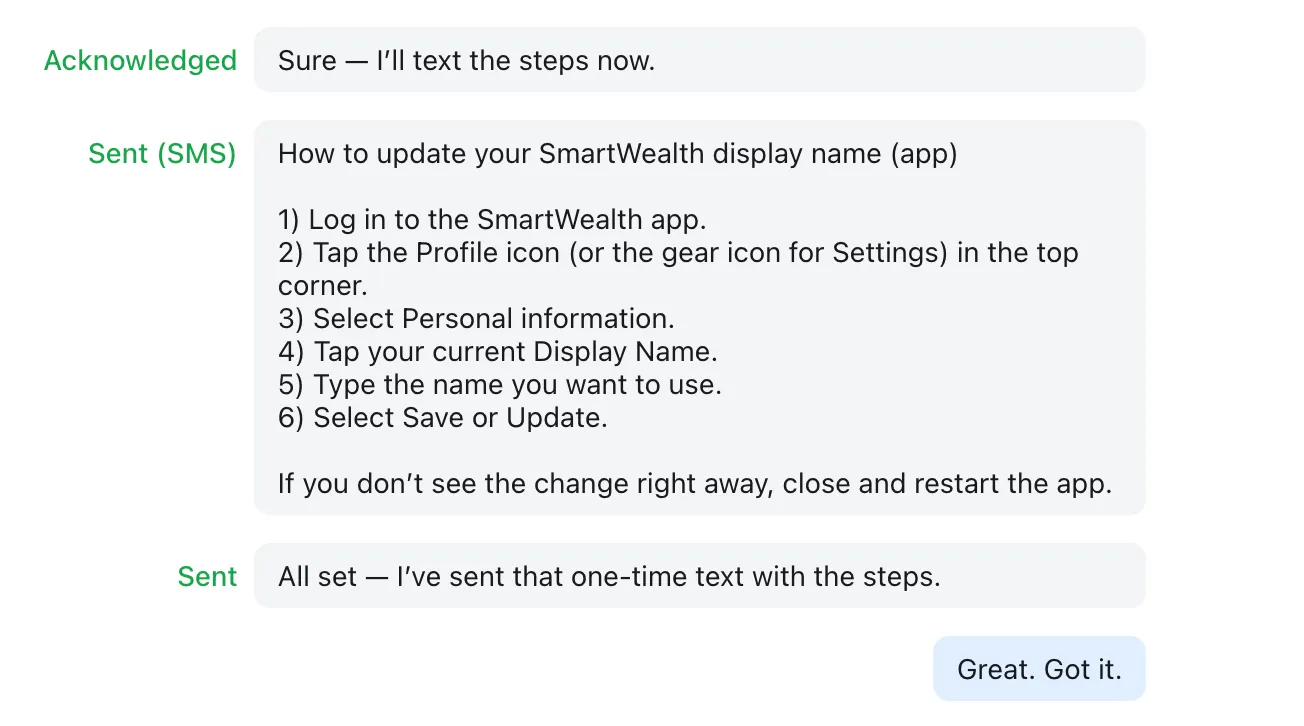
This gives you complete visibility into the messages your AI Agent sends to end users via SMS, so you can review exactly what was communicated and how it contributed to resolving the conversation.
To learn more about reviewing conversations, see Conversations.